
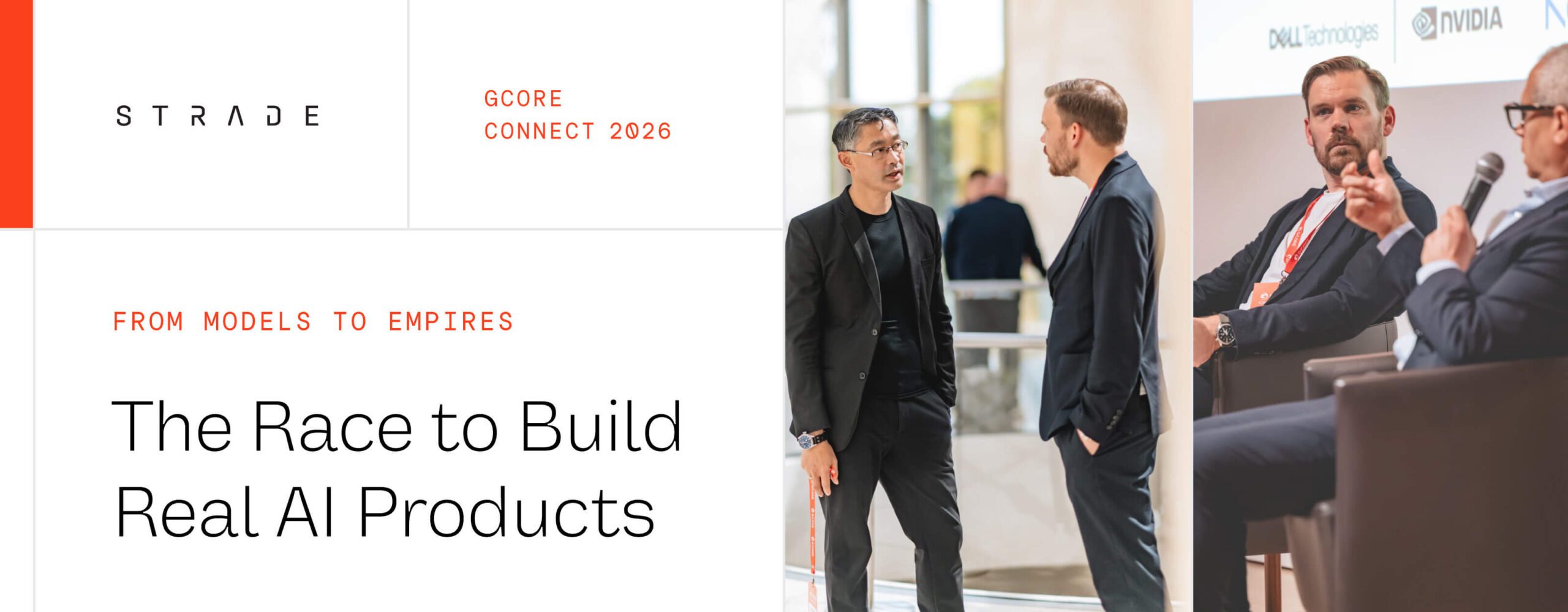
From Models to Value: STRADE’s Perspective from Gcore Connect 2026
From Models to Value: STRADE's Perspective from Gcore Connect 2026
This week, STRADE Co-CEO and Founder Job Arnold joined technology leaders, policymakers, researchers, and entrepreneurs at Gcore Connect 2026 in Luxembourg, an invitation-only forum exploring the future of artificial intelligence, digital infrastructure, and innovation in Europe. The event brought together speakers from across the AI ecosystem, including Dr. Philipp Rösler, former Vice Chancellor of Germany and a figure pivotal in the creation of STRADE, as well as Prof. Dr. Feiyu Xu, one of Europe's leading AI experts. Discussions ranged from digital sovereignty and AI infrastructure to Europe's position in the global AI race.
Much of the discussion focused on AI infrastructure, digital sovereignty, and Europe's position in the global AI race. Yet one question sat beneath many of the conversations: as access to advanced AI becomes increasingly widespread, what will actually differentiate successful organizations?
For Job, the answer is not the model itself. It is an organization's ability to understand customer needs, empower people, foster continuous learning, and continuously reinvent how it works. In a world where technology is increasingly accessible, the ability to learn and adapt may become the most sustainable competitive advantage.
The Model Is Not the Advantage
As part of the session "From Models to Empires: The Race to Build Real AI Products," Job shared a perspective that challenges a common assumption in today's AI debate. "Ten years ago you needed big data. Today, you can rent the frontier model and apply it around existing workflows."
Access to powerful AI models is becoming increasingly democratized. As a result, technology alone is no longer the differentiator. Competitive advantage comes from understanding customer needs, designing better workflows, and creating value faster than others. "We don't need to build empires. Everyone has the same access: the model is a commodity, not your competitive advantage."
For STRADE, this principle is familiar. Technology only creates value when it solves real problems. In the aviation aftermarket, success depends less on access to tools and more on how effectively they are applied to improve decision-making, reduce friction, and create better outcomes for customers.
Realizing that value requires more than adopting new technology. It requires organizations and individuals to stay curious, embrace change, and rethink established ways of working. As AI capabilities evolve at unprecedented speed, learning is no longer simply a desirable trait - it is a prerequisite for remaining relevant.

The Courage to Disrupt Yourself
This shift raises an important leadership question. If new technologies are increasingly capable of supporting decisions and executing tasks, organizations must first create an environment where people are trusted to think independently, challenge assumptions, and drive change. As Job put it during the event: "If you don't give your people agency, how will you ever entrust the machine?”
A recurring theme throughout the forum was the speed at which AI continues to evolve. "This is the worst AI we will ever work with" Job remarked, highlighting the pace of technological progress. Yet despite rapid advances, many organizations are still at an early stage of translating AI's potential into everyday business value. The challenge is often not access to technology, but the willingness to rethink how work gets done.
This challenge resonates closely with Joseph Schumpeter's concept of creative destruction - the idea that successful organizations continuously reinvent themselves rather than protect existing ways of working. At STRADE, that means regularly revisiting products, processes, and ways of working through the lens of today's technological possibilities. As technology evolves, decisions, workflows, and collaboration models must evolve with it.
Successful AI adoption therefore starts with culture. Employees need the freedom to explore new approaches, challenge established practices, and take ownership of transformation. Organizations that continuously learn, adapt, and rethink how work gets done are ultimately better positioned to create value for customers. Technology can accelerate change, but people determine whether that change succeeds.
Europe's Opportunity
Discussions also explored Europe's role in the global AI landscape. While challenges remain, participants highlighted Europe's strengths in talent, research, industrial expertise, and trusted innovation. As Dr. Philipp Rösler noted during the forum, innovation only creates impact when there is a market for it. The conversation reinforced a view shared by many attendees: Europe's opportunity lies not only in developing technology, but in translating innovation into real-world applications that create value.
Looking Ahead
Gcore Connect 2026 provided a valuable opportunity to exchange perspectives with leaders from technology, business, academia, and government. STRADE thanks Gcore for creating a forum that encouraged thoughtful discussion about both the opportunities and realities of AI adoption.
For Job, one message stood out above all others: organizations cannot assume that yesterday's ways of working will remain relevant tomorrow. As AI continues to evolve, success will depend less on access to technology and more on the willingness to continuously learn, adapt, and challenge established assumptions. Or, in the spirit of Schumpeter's concept of creative destruction, the organizations best positioned for the future may be those prepared to disrupt themselves before someone else does.